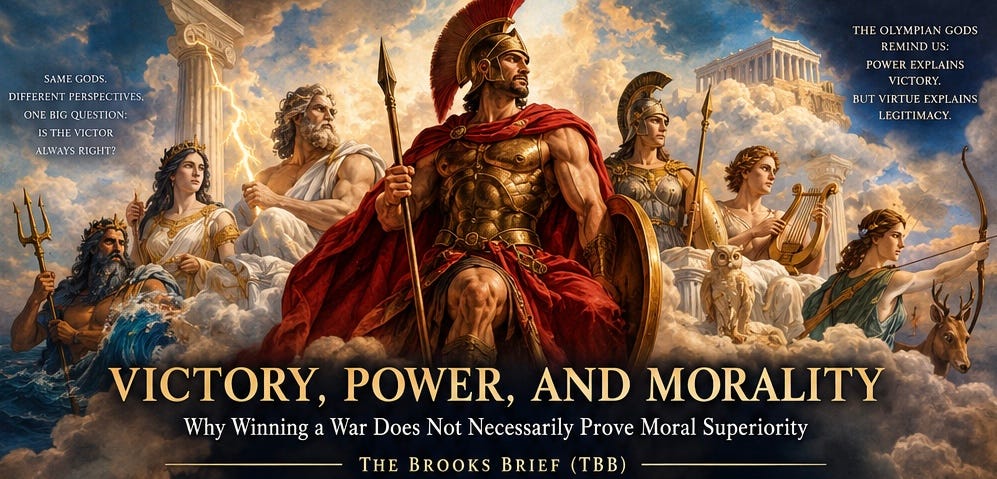
Why Winning a War Does Not Necessarily Prove Moral Superiority
Introduction: The Problem of Equating Victory With Virtue
Military history is frequently presented as a contest in which the victorious side ultimately proves the superiority of its cause. This interpretation is understandable because victory creates tangible political results, while defeat often leaves the losing side without the institutional power to preserve its preferred narrative. Yet military victory and moral legitimacy are fundamentally different concepts. A state can win a war because it possesses superior weapons, stronger logistics, greater industrial capacity, better intelligence, more powerful alliances, or greater manpower. None of those advantages, by themselves, establishes that the victorious state was morally right.

The central political science question is therefore not simply who won, but why they won and what that victory actually demonstrates. Military victory demonstrates that one side was able to impose its will more effectively under the conditions of a particular conflict. Moral legitimacy requires a different inquiry involving the causes of the conflict, the objectives of the participants, the methods used, and the consequences produced. A technologically superior military may defeat a poorly equipped opponent while pursuing an unjust objective. Conversely, a morally justified movement may lose because it lacks the resources necessary to defeat a materially superior adversary.
This distinction is essential because political power frequently influences the production of historical narratives. Victorious governments are often better positioned to preserve archives, establish educational curricula, erect monuments, influence media institutions, and define the official interpretation of a conflict. Defeated governments may lose not only territory and political authority but also the institutional ability to explain their actions to future generations. The result can be a dangerous intellectual shortcut in which historical survival is mistaken for moral correctness. A serious political science analysis must therefore distinguish between the fact of victory and the legitimacy of the political order created by victory.
I. Winning and Being Right Are Different Political Questions

Military victory answers a relatively straightforward question: which side possessed the ability to achieve its strategic objectives through the application of force? Political victory is somewhat broader because it concerns whether those military gains produced a durable political settlement. Legal legitimacy asks whether the conduct of the participants complied with applicable laws and international norms. Moral legitimacy goes further by asking whether the objectives themselves were ethically defensible and whether the methods used to achieve them were proportionate and justified. These questions can produce different answers concerning the same conflict.
A military commander may be extraordinarily successful while serving a government pursuing questionable objectives. Likewise, a soldier can demonstrate courage and discipline without personally determining whether the war itself is morally justified. This distinction between individual conduct and state policy is particularly important when analyzing large conflicts. Political leaders establish objectives, military institutions implement those objectives, and individual participants operate within systems of authority. Assigning the moral character of an entire war solely from its outcome therefore risks ignoring the complicated chain of political responsibility.
The opposite mistake is equally problematic. The fact that a losing side possessed a legitimate grievance does not mean every action undertaken by that side was justified. Political movements can begin with legitimate complaints and subsequently employ illegitimate methods. Governments can defend their populations while simultaneously committing abuses against civilians. Armed resistance can be understandable without every act of resistance being morally permissible. A rigorous framework must therefore evaluate both sides according to consistent standards rather than allowing victory or defeat to determine the answer in advance.
II. The Material Foundations of Military Victory

Military technology can dramatically influence the outcome of wars. Firearms, artillery, aircraft, naval vessels, armored vehicles, missiles, surveillance systems, communications networks, precision weapons, and other technologies can provide enormous advantages to forces that possess them. Technological superiority can increase accuracy, range, mobility, defensive capability, and destructive power. When one side possesses significantly more advanced weapons, the battlefield may become structurally unequal before the first major engagement occurs. Consequently, military victory can sometimes tell us more about relative capabilities than about relative moral worth.
Weaponry, however, is only one element of military power. Industrial production determines whether a nation can replace destroyed equipment and maintain prolonged operations. Logistics determine whether soldiers can receive food, ammunition, fuel, medical treatment, and replacement personnel. Intelligence can allow a weaker force to anticipate the movements of a stronger opponent. Alliances can provide additional manpower, technology, financial support, diplomatic legitimacy, and access to strategically important territory. Geography, leadership, training, morale, and political cohesion can also determine whether technological advantages translate into actual victory.
The relationship between weapons and morality becomes especially complicated when technological superiority produces overwhelming battlefield results. A side may possess the ability to destroy an opponent’s military infrastructure without possessing a corresponding moral justification for the political objectives it seeks. Technology can make victory easier without making the underlying cause more legitimate. This distinction becomes increasingly important as modern weapons allow states to project power across enormous distances and inflict devastating effects with comparatively limited exposure to their own forces. The ability to win efficiently should therefore never be confused automatically with the right to win.
III. The Victor’s Advantage in Writing History

Victory frequently creates an institutional advantage that extends beyond the battlefield. Governments that survive wars can preserve official records, establish museums, control public commemorations, and influence the education of future generations. They may also determine which historical figures become heroes and which become villains. Over time, these institutional decisions can transform political interpretations into seemingly objective historical truths. The result is not necessarily deliberate deception, but it can produce a systematic imbalance in whose perspective receives lasting recognition.
This phenomenon can be described as narrative asymmetry. The victor possesses greater political capacity to preserve its interpretation of events, while the defeated side may experience censorship, occupation, political collapse, territorial displacement, or the destruction of its institutions. Historical memory can consequently become part of the spoils of political victory. A state that wins a war may gain not only territory or security but also greater influence over the language used to describe the conflict. This does not mean that victorious narratives are necessarily false, but it does mean that political scientists and historians should examine them critically.
The existence of victor-controlled narratives does not justify automatically adopting the perspective of the defeated side either. Losing governments can produce propaganda, conceal atrocities, exaggerate their achievements, or manipulate public opinion just as victorious governments can. The appropriate response is therefore not to reverse the traditional hierarchy and assume that the loser was secretly correct. Instead, researchers should examine multiple sources, compare competing accounts, identify corroborating evidence, and distinguish documented facts from political interpretation. Historical truth should emerge from evidence rather than from the scoreboard of war.
IV. Technology and the Changing Meaning of Warfare

Every major technological transformation has changed the relationship between military power and political authority. The introduction of gunpowder altered the balance between traditional aristocratic warriors and centralized states. Industrialization enabled governments to mobilize enormous armies and sustain prolonged conflicts. Air power created new strategic possibilities by allowing combatants to attack targets far beyond traditional battlefields. Nuclear weapons subsequently transformed the concept of deterrence by creating the possibility that victory itself could become catastrophic for both sides.
Technological development also changes the moral questions surrounding warfare. When weapons become more destructive, questions of proportionality and civilian protection become increasingly significant. When surveillance becomes more sophisticated, governments gain greater capacity to identify threats but also greater capacity to monitor populations. When autonomous or remotely operated systems become more capable, political leaders may face fewer immediate costs when authorizing military action. Technology can therefore increase military effectiveness while simultaneously creating new ethical dilemmas.
The fundamental principle remains that technology explains capability rather than righteousness. A state possessing superior weapons may have greater power to determine the outcome of a conflict, but its technological advantage does not establish the legitimacy of its political objectives. The same principle applies to weaker states and nonstate actors. Technological inferiority does not transform an actor into a moral hero. Political science must therefore analyze the relationship between technological capacity, strategic behavior, political objectives, and ethical constraints rather than treating technological advancement as evidence of virtue.
V. Asymmetric Warfare and the Limits of Military Superiority

History demonstrates that military superiority does not always translate into political control. A technologically dominant power may defeat conventional armies while struggling to eliminate an insurgency or sustain a favorable political settlement. Weaker actors can sometimes compensate for inferior weapons through geography, local support, unconventional tactics, intelligence networks, political organization, and persistence. The resulting conflicts demonstrate that warfare is not merely a contest between weapons systems. It is also a contest between political institutions, social structures, competing narratives, and competing perceptions of legitimacy.
Asymmetric warfare also demonstrates why political victory can differ from battlefield victory. A powerful military may win numerous engagements yet fail to accomplish its larger political objectives. Conversely, a weaker movement may lose individual battles while achieving enough political pressure to force negotiations or withdrawal. The distinction between tactical success and strategic success is therefore essential. A battlefield victory matters, but its political meaning depends upon what happens afterward. Military historians and political scientists must consequently evaluate wars over longer time horizons rather than focusing exclusively on individual battles.
Yet asymmetric warfare should not romanticize the weaker side. A smaller or technologically inferior force can employ terrorism, coercion, attacks against civilians, or other morally objectionable methods. The fact that an actor faces a powerful opponent does not give it unlimited moral permission. Similarly, a powerful state does not acquire unlimited authority simply because it claims to be fighting terrorism or defending national security. Both sides remain subject to ethical and legal evaluation. The principle of consistent standards is particularly important when political sympathy risks replacing objective analysis.
VI. War as a Contest of Power

Realist political theory provides one explanation for why military outcomes frequently reflect material capabilities rather than moral superiority. From a realist perspective, states operate in an international environment where security, survival, strategic interests, and power are central concerns. Governments therefore accumulate military capabilities because they cannot always depend upon other governments to protect them. Under this framework, superior weapons are valuable because they increase a state’s ability to deter threats and impose costs upon adversaries. Victory can consequently be understood as a demonstration of power rather than a divine or moral judgment.
Liberal political theory offers a different perspective by emphasizing institutions, international law, cooperation, democratic governance, and rules governing state behavior. From this perspective, military victory is only one component of legitimacy. A state that wins a war but violates fundamental legal and political principles may undermine the legitimacy it claims to defend. International institutions can therefore provide mechanisms for evaluating conduct independently of battlefield outcomes. The liberal perspective reinforces the idea that power and legitimacy should not be treated as interchangeable concepts.
Constructivist political theory adds another dimension by emphasizing identity, norms, historical memory, and shared understandings. States do not merely fight over physical territory or resources. They also fight over interpretations of who they are, what they believe, and what political order they consider legitimate. A victorious state may therefore attempt to construct a postwar identity that presents its victory as evidence of historical righteousness. Understanding this process requires studying not only weapons and armies but also language, symbols, education, religion, nationalism, and collective memory.
VII. The Ethics of Judging the Victor
A serious evaluation of a victorious power should begin with the same questions applied to any other political actor. What caused the conflict? What objectives did each side pursue? Were those objectives defensive, expansionist, ideological, economic, or some combination of factors? What methods were employed against combatants and civilians? Were peaceful alternatives available before violence escalated? These questions allow researchers to evaluate the conflict without assuming the answer from the beginning.
The treatment of civilians is particularly important because military necessity cannot automatically justify every action. Modern political thought increasingly emphasizes the distinction between legitimate military targets and civilian populations. Governments may have legitimate security concerns while still being responsible for preventing unnecessary suffering. Similarly, resistance movements may possess legitimate political grievances while remaining responsible for the consequences of their methods. Moral analysis therefore requires examining conduct as well as objectives.
The postwar period provides another important test. A victorious power can use its position to pursue reconstruction, reconciliation, institution building, and political stability. It can also use victory to pursue revenge, domination, economic exploitation, or permanent occupation. The manner in which power is exercised after the fighting ends can reveal whether victory produced a legitimate political order or merely replaced one form of domination with another. Consequently, victory should be viewed as the beginning of a political evaluation rather than the conclusion of one.
VIII. The Postwar Construction of Legitimacy

Victory gives a state an opportunity to demonstrate that its use of power served a legitimate political purpose. Reconstruction can create economic stability and improve the lives of populations that suffered during conflict. Reconciliation can reduce the likelihood that grievances will produce another generation of violence. Democratic institutions can give former opponents peaceful mechanisms for resolving political disagreements. These actions can strengthen the moral legitimacy of a victorious government even when the original conflict remains historically contested.
The opposite is also possible. Victorious governments can become authoritarian after defeating external enemies. Emergency powers created during wartime can become permanent restrictions on civil liberties. Military institutions can gain excessive political influence. Economic resources can become concentrated among elites who benefited from the conflict. In these circumstances, victory may strengthen the state without strengthening the legitimacy of its political system.
This demonstrates why the aftermath of war deserves as much attention as the battlefield itself. The ultimate political question is not simply whether one government defeated another. It is whether the resulting political order is capable of producing security, justice, stability, and legitimate governance. A victory that produces sustainable peace may have a different historical meaning from a victory that produces decades of repression. Political scientists must therefore evaluate the institutions created by victory rather than treating military success as the final measure of political achievement.
IX. Why the Loser Is Not Automatically the Victim

Rejecting the idea that the victor is always morally right should not lead to the opposite assumption that the defeated side was morally superior. Political actors can commit serious wrongdoing regardless of whether they ultimately win or lose. Some governments initiate wars for territorial expansion, political ideology, economic gain, or national prestige. Others may use propaganda to mobilize populations against perceived enemies. Defeat does not erase those actions, just as victory does not erase wrongdoing committed by the winner.
The temptation to romanticize the defeated side often emerges because history is sympathetic toward those who suffer. There is legitimate value in examining the experiences of populations subjected to occupation, displacement, or political repression. However, suffering alone does not establish that the political leadership responsible for the conflict was justified. Political analysis must separate civilians from governments, soldiers from policymakers, and legitimate grievances from illegitimate methods. Without these distinctions, historical analysis can become another form of propaganda.
The most defensible approach is therefore symmetrical evaluation. The same questions should be asked of the winner and the loser. What did they want? What did they do? What alternatives did they have? What rules governed their conduct? What were the consequences of their decisions? By applying consistent standards, political science can avoid transforming military outcomes into automatic moral verdicts.
X. Victory as Evidence of Capability, Not Virtue

The central lesson of this analysis is that military victory demonstrates capability under specific historical conditions. It can demonstrate superior organization, technology, logistics, strategy, alliances, leadership, resources, or political cohesion. It can demonstrate that one side was better positioned to impose its will on the battlefield. What it cannot demonstrate by itself is that the winning side possessed superior moral principles. That conclusion requires an entirely separate body of evidence.
Superior weaponry is particularly important because military technology can create enormous differences in battlefield outcomes. A technologically advanced force may destroy an opponent that lacks comparable capabilities. Industrial strength can allow a state to replace losses while its opponent cannot. Intelligence systems can reveal enemy positions, while superior communications can coordinate forces across vast distances. These capabilities can produce decisive victory without resolving the underlying philosophical question of whether the war itself was justified.
This distinction has implications far beyond historical scholarship. Modern governments routinely justify military expenditures by emphasizing threats, security, deterrence, and technological superiority. Citizens therefore need the intellectual tools to distinguish the ability to fight from the legitimacy of fighting. A powerful military can protect a legitimate political order, but it can also be used in pursuit of questionable objectives. Democratic societies are strongest when they can maintain both effective defense and rigorous scrutiny of the reasons for using force.
XI. Conclusion: Separating Power From Moral Judgment

The equation of victory with righteousness is one of the most persistent assumptions in the political interpretation of war. It is attractive because victory produces visible results, while morality requires more complicated judgments. A defeated power loses territory, institutions, prestige, and often the ability to control its historical narrative. A victorious power gains the authority to shape the postwar environment and frequently possesses greater resources with which to defend its interpretation of events. Yet neither battlefield success nor political dominance provides automatic proof of moral superiority.
A more rigorous framework begins by separating military capability from moral legitimacy. Weapons, logistics, industrial capacity, intelligence, alliances, leadership, and strategy can explain why one side wins. Political legitimacy requires examining whether the objectives pursued were defensible and whether the methods employed were lawful and ethical. Historical legitimacy requires examining the evidence and considering competing interpretations. These are related questions, but they are not identical questions.
Ultimately, political science should resist the idea that history itself awards moral trophies to the winners. The victor may have had better weapons, better logistics, better alliances, better strategy, or simply better circumstances. The loser may have possessed legitimate grievances, unjust objectives, or some combination of both. The winner may have been justified in some actions and unjustified in others, just as the loser may have been justified in some actions and unjustified in others. The mature political conclusion is therefore simple: victory proves that one side was able to win the war, but it does not by itself prove that the side was morally right. Understanding the difference between power and righteousness is essential to understanding war, history, and the political construction of legitimacy.




Leave a Reply