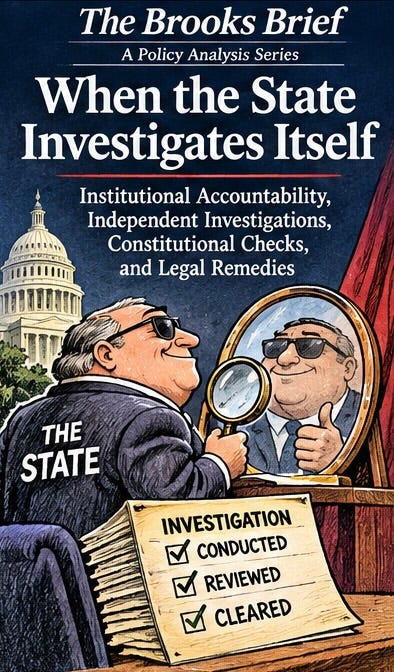
Federal Power, Institutional Impunity, and the Collapse of Accountability
Sequel to When the State Kills Its Own: Federal Agents, Legal Immunity, and the Crisis of Accountability
Introduction: The Government as Judge of Its Own Conduct
The legitimacy of a constitutional government rests upon a fundamental distinction between the authority to exercise power and the authority to determine whether that power has been exercised lawfully. When government officials investigate allegations against members of their own institutions, this distinction becomes increasingly difficult to maintain. The state possesses extraordinary powers to investigate, arrest, detain, prosecute, and, under narrowly defined circumstances, use deadly force against individuals. These powers are granted for the protection of society, not for the preservation of the institutions exercising them. Yet the same government that authorizes these actions frequently controls the evidence, personnel, investigative procedures, and prosecutorial decisions used to determine whether misconduct occurred. This concentration of authority presents a fundamental question for constitutional democracy: Can a government credibly guarantee accountability when it retains substantial control over the mechanisms designed to hold itself accountable?
In January 2026, The Brooks Brief examined this question through the deaths of Alex Pretti and Renée Good during federal immigration enforcement operations in Minneapolis. The original analysis, When the State Kills Its Own, explored the relationship between federal law enforcement, qualified immunity, constitutional protections, and the difficulties victims’ families may encounter when pursuing legal remedies. The central concern extended beyond the circumstances of either death to the institutional arrangements governing investigations into the use of deadly force. Since that publication, disputes between Minnesota authorities and federal officials have demonstrated that the issue is not confined to whether an officer’s actions were legally justified. It also concerns who possesses the authority to collect evidence, question witnesses, examine government records, and determine whether criminal proceedings are warranted. These developments transform the original discussion of legal immunity into a broader examination of institutional independence, federalism, and the separation of powers.
The present analysis examines the structural consequences of allowing government institutions to exercise substantial influence over investigations involving their own personnel. It does not presume that every government investigation is corrupt, that every officer accused of misconduct is guilty, or that federal agencies are incapable of conducting legitimate internal reviews. Rather, it considers whether existing safeguards are sufficient to distinguish impartial investigations from institutional self-protection when serious allegations arise. The inquiry draws upon constitutional law, political theory, judicial precedent, and contemporary disputes involving federal law enforcement. Particular attention is given to the relationship between investigative independence and meaningful legal remedies, because constitutional protections cannot be evaluated solely by their existence in written law. They must also be evaluated by the practical ability of individuals to invoke those protections against the institutions responsible for violating them.
I. The Monopoly on Legitimate Force and the Limits of State Authority

Political sociologist Max Weber famously characterized the modern state through its claim to a monopoly on the legitimate use of physical force within a defined territory. This formulation does not suggest that every government exercise of force is automatically legitimate, nor does it establish that governments possess unlimited authority over the populations they govern. Instead, it identifies the state’s distinctive claim to regulate when coercion may be lawfully exercised and by whom. Police officers, federal agents, military personnel, and correctional officials derive their authority from legal institutions that authorize particular forms of coercion under specified conditions. The legitimacy of these institutions therefore depends upon more than their capacity to enforce commands or overcome resistance. It also depends upon the legal and political constraints that prevent authorized coercion from becoming arbitrary domination.
In the American constitutional system, the government’s authority to use force is constrained by provisions protecting individuals against unreasonable seizures and deprivation of liberty without due process of law. The Fourth Amendment establishes important limitations on searches, arrests, and the use of force during seizures, while the Fifth and Fourteenth Amendments impose additional constitutional protections according to the governmental conduct involved. These guarantees reflect a political arrangement in which public officials exercise delegated authority rather than unlimited personal power. The Supreme Court’s decision in Graham v. Connor (1989) established that claims involving excessive force during an arrest or investigatory stop are generally evaluated under the Fourth Amendment’s objective reasonableness standard. That standard requires consideration of the circumstances confronting an officer, including the severity of the suspected offense, the immediacy of any threat, and whether the individual was resisting or attempting to evade arrest. Consequently, an officer’s legal authority to perform an enforcement operation does not independently establish that every use of force during that operation was constitutionally reasonable.
United States Department of Justice
The distinction between governmental authority and governmental legitimacy becomes especially important when an enforcement operation results in death. An individual may have violated a law without creating circumstances that justify deadly force, just as an officer may possess lawful arrest authority without possessing unlimited discretion over how an arrest is conducted. Conversely, a lawful use of deadly force may occur when an officer reasonably confronts an imminent threat of death or serious bodily injury, even if the encounter produces tragic consequences. Constitutional accountability therefore requires an examination of the facts rather than a presumption that either the government or the deceased individual must have acted unlawfully. The state’s monopoly on legitimate force cannot be interpreted as a monopoly on determining the legitimacy of its own actions without meaningful external scrutiny. When investigative procedures fail to preserve this distinction, the government’s claim to lawful authority risks becoming inseparable from its institutional interest in defending itself.
II. Minneapolis and the Institutional Conflict Over Evidence

The deaths of Renée Good on January 7, 2026, and Alex Pretti on January 24, 2026, became significant not only because federal agents used deadly force, but also because the subsequent investigations generated disputes between federal and Minnesota authorities. State officials sought access to evidence and investigative materials necessary to conduct their own reviews of the shootings. Federal authorities initially resisted aspects of that cooperation, prompting questions about the ability of state investigators to examine actions committed by federal personnel within Minnesota’s jurisdiction. In March, Minnesota officials pursued litigation seeking evidence and cooperation from federal agencies, demonstrating how an investigation into potentially unlawful conduct could develop into a separate legal dispute over investigative authority. The controversy raised questions concerning federal supremacy, state criminal jurisdiction, evidentiary access, and the practical limits of intergovernmental cooperation. These questions are not merely administrative because the ability to obtain evidence can determine whether an investigation is capable of reaching a defensible conclusion.
The dispute continued beyond the immediate aftermath of the shootings, revealing the instability of investigative arrangements that depend heavily upon discretionary cooperation. According to reporting published in October 2026, Minnesota officials stated that federal authorities had again stopped sharing evidence after a period in which cooperation had resumed. Materials reportedly sought by state investigators included recorded interviews, firearms, ammunition-related evidence, electronic devices, and other items relevant to reconstructing the encounters. Federal officials maintained that disclosure of certain materials remained subject to federal rules and agency discretion, while Minnesota authorities argued that withholding evidence obstructed their ability to conduct independent investigations. As of the October reporting, no criminal charges had been filed in either shooting, although the absence of charges does not itself establish whether the underlying uses of force were lawful. The resulting conflict illustrates how the allocation of investigative control can become as consequential as the substantive legal standards governing an officer’s conduct.
From an institutional perspective, the central problem is not simply that two levels of government disagree over investigative procedures. It is that the institutions possessing potentially decisive evidence may also have an organizational interest in the outcome of the inquiry. This does not establish that federal officials deliberately concealed wrongdoing, and allegations of obstruction must be distinguished from judicial findings establishing unlawful conduct. Nevertheless, a credible accountability system should not depend exclusively upon the willingness of an institution under scrutiny to provide information to another investigative authority. Evidence preservation, witness access, forensic examination, and the documentation of investigative decisions are essential to determining whether an officer acted lawfully. When these functions become subjects of prolonged jurisdictional conflict, the public may reasonably question whether the process is designed primarily to establish the facts or to protect institutional prerogatives. The Minneapolis disputes therefore offer a contemporary case study in the relationship between investigative independence and the constitutional legitimacy of government power.
III. Federalism and the Constitutional Balance of Investigative Authority

Federalism distributes governmental authority between the national government and the states, creating overlapping responsibilities that can produce both cooperation and conflict. The Supremacy Clause establishes that valid federal law takes precedence over conflicting state law, but it does not automatically exempt federal personnel from every generally applicable state criminal law. Under the doctrine associated with In re Neagle (1890), federal officers may receive protection against state prosecution when their challenged actions were authorized by federal law and necessary and proper to the performance of their federal duties. The availability of such protection depends upon the applicable legal standards and the circumstances of the conduct under examination. Consequently, federal employment alone does not conclusively establish that an officer’s actions are beyond the reach of state criminal law. The constitutional difficulty lies in determining when state enforcement would impermissibly interfere with legitimate federal functions and when federal immunity claims would improperly prevent accountability for unlawful conduct.
The relationship between state investigative authority and federal institutional protection becomes particularly complex when evidence is held by federal agencies. State investigators ordinarily possess substantial authority to investigate suspected violations of state criminal law, but that authority does not eliminate federal restrictions governing the disclosure of agency records and employee testimony. Federal regulations commonly described as Touhy regulations establish procedures through which agencies respond to demands for official information and testimony. These procedures can protect legitimate governmental interests, including sensitive investigations, privileged communications, and the orderly administration of federal responsibilities. However, they can also create procedural obstacles when state prosecutors seek materials relevant to alleged criminal misconduct by federal officers. In the Minneapolis litigation, the struggle over access to evidence demonstrated that a state’s theoretical authority to investigate possible crimes may be significantly constrained by its practical ability to obtain information.
The political significance of this conflict extends beyond the legal question of which government possesses superior authority in a particular proceeding. Federalism was designed partly to prevent the excessive concentration of governmental power by distributing authority among institutions with distinct responsibilities and constituencies. State governments can serve as additional sources of oversight when federal institutions fail to address legitimate concerns, just as federal courts can restrain unconstitutional actions by state officials. This arrangement becomes less effective when one institution can substantially obstruct another’s investigation without timely and meaningful judicial review. At the same time, state officials must not be permitted to use criminal investigations as instruments for undermining lawful federal operations or pursuing partisan retaliation. An effective constitutional framework must therefore protect legitimate federal functions while preserving independent mechanisms for investigating credible allegations of criminal conduct. The objective should not be unconditional federal supremacy or unrestricted state intervention, but a system in which jurisdictional boundaries do not become barriers to establishing the truth.
IV. The Separation of Powers and the Problem of Institutional Self-Protection

The American constitutional system was constructed around the recognition that political power requires institutional restraints because officials cannot always be expected to regulate themselves voluntarily. James Madison articulated this concern in Federalist No. 51, explaining that constitutional government must establish arrangements through which competing institutions restrain the accumulation of authority. The legislative branch creates laws and exercises oversight, the executive branch administers and enforces those laws, and the judiciary resolves legal controversies within its constitutional jurisdiction. Although these functions are not completely isolated, their distribution is intended to reduce the possibility that any single institution can exercise unchecked authority. Federal law enforcement agencies operate within the executive branch, meaning that investigations, disciplinary proceedings, and prosecutorial decisions may involve institutions ultimately accountable to the same presidential administration. This arrangement creates potential conflicts between the executive branch’s responsibility to enforce the law impartially and its political interest in defending the conduct of its own personnel.
Institutional self-protection does not necessarily require an explicit conspiracy, unlawful directive, or deliberate attempt to conceal evidence. Organizations develop internal cultures, professional loyalties, reputational concerns, and administrative incentives that may influence how officials interpret allegations involving their colleagues. Supervisors may hesitate to acknowledge failures that could reflect poorly upon their leadership, while investigators may face professional pressures when examining misconduct involving influential officials. Prosecutors may also encounter difficult decisions when the individuals under investigation belong to agencies with which they maintain extensive working relationships. These structural incentives do not prove that any particular investigation has been compromised, but they demonstrate why independence cannot be measured solely by the personal integrity of the investigators involved. A system designed around the assumption that every official will resist institutional pressure is less reliable than one that anticipates conflicts of interest and establishes safeguards against them. Constitutional accountability should therefore be evaluated through institutional design rather than through unconditional confidence in the character of individual officeholders.
Congress possesses several mechanisms for examining executive conduct, including oversight hearings, legislative investigations, appropriations restrictions, and the authority to establish statutory reporting requirements. Federal courts can adjudicate legal challenges, review agency conduct where jurisdiction exists, and order appropriate relief when applicable legal standards are satisfied. Inspectors general provide another important source of oversight by investigating waste, fraud, abuse, and misconduct within federal institutions. However, each mechanism operates within legal and practical limitations that can affect its independence, effectiveness, and access to information. Congressional oversight may be weakened by partisan incentives, judicial review may depend upon standing and the availability of a cause of action, and inspectors general may encounter restrictions involving classified information or executive control. The separation of powers is therefore not a self-executing guarantee of accountability, but a constitutional framework that requires functioning institutions capable of exercising their assigned responsibilities.
V. Qualified Immunity, Sovereign Immunity, and the Limits of Constitutional Remedies

One of the most important distinctions in evaluating governmental accountability is the difference between a constitutional violation and the availability of a legal remedy for that violation. The existence of a constitutional right does not automatically establish that an injured individual can obtain monetary damages from every government official or agency involved. Qualified immunity generally protects government officials performing discretionary functions from personal liability for civil damages unless their conduct violates clearly established statutory or constitutional rights. The doctrine is principally associated with civil litigation and does not itself prohibit criminal prosecution or internal disciplinary proceedings. Its application also depends upon the existence of an otherwise legally available claim against the individual official. Consequently, an analysis of federal law enforcement accountability must examine qualified immunity alongside the separate legal doctrines governing whether a lawsuit can proceed at all.
For federal officers, the availability of constitutional damages actions has been significantly influenced by the Supreme Court’s treatment of Bivens v. Six Unknown Named Agents (1971). In Bivens, the Court recognized an implied damages remedy against federal officers for a particular Fourth Amendment violation involving an unlawful search and arrest. Subsequent decisions recognized limited additional contexts, but the Court has become increasingly reluctant to authorize new constitutional damages actions without congressional legislation. In Egbert v. Boule (2022), the Supreme Court declined to extend a Bivens remedy to claims involving a Border Patrol agent, emphasizing institutional concerns about judicial creation of damages remedies. The majority reasoned that Congress was generally better positioned to determine whether additional forms of liability should be authorized, while dissenting justices criticized the consequences of further restricting judicial remedies. The decision illustrates how an individual may encounter a significant legal obstacle before a court reaches the separate question of whether an officer’s conduct violated clearly established law.
Supreme Court
Sovereign immunity introduces another layer of complexity because lawsuits against the United States ordinarily require a statutory waiver of governmental immunity. The Federal Tort Claims Act permits certain civil claims against the federal government for wrongful conduct by federal employees, subject to jurisdictional requirements, exceptions, and other limitations. These claims are not interchangeable with constitutional damages actions against individual officers, and the availability of one remedy does not guarantee the availability of another. Federal criminal civil rights statutes, including 18 U.S.C. § 242, provide potential mechanisms for prosecuting willful deprivations of constitutional rights under color of law, but criminal liability requires proof of specific statutory elements beyond a reasonable doubt. Internal disciplinary proceedings operate under different standards and may result in administrative consequences even when criminal charges are not pursued. The resulting framework is fragmented, with civil liability, constitutional remedies, criminal prosecution, and administrative discipline functioning through distinct legal processes that do not necessarily produce the same outcomes.
VI. The Difference Between an Investigation and an Independent Investigation

An investigation is not independent merely because it is conducted by a unit with a different name or administrative designation from the organization whose personnel are under examination. Genuine independence requires sufficient separation from the individuals, supervisory structures, and institutional interests implicated by the alleged misconduct. It also requires practical authority to obtain evidence, interview witnesses, preserve records, retain qualified forensic specialists, and reach conclusions without improper interference. An investigative office may possess formal independence while remaining dependent upon the investigated agency for access to critical information. Conversely, an internal investigation may produce reliable findings when investigators have appropriate safeguards, professional standards, and effective external review. The essential question is therefore whether the investigative process can function impartially when its findings threaten the interests of powerful officials or institutions.
The January 2026 Minneapolis shootings demonstrated the importance of distinguishing investigative authority from investigative access. Minnesota officials asserted an interest in examining whether federal agents had violated state criminal law, while federal authorities exercised substantial control over materials relevant to those inquiries. Human Rights Watch raised concerns about restrictions on state investigators’ access to evidence and called for independent investigation and congressional oversight following the shootings. These concerns were intensified by disputes involving the handling of evidence, access to shooting scenes, and public statements made before investigative findings had been fully established. The existence of competing governmental narratives does not determine which account is accurate, but it increases the importance of an evidence-based process that is demonstrably impartial. Where public confidence has deteriorated, the appearance of independence may be insufficient unless accompanied by verifiable procedures and meaningful disclosure.
Human Rights Watch
Independent investigations should not be designed to guarantee prosecutions, predetermined findings of wrongdoing, or outcomes favorable to public opinion. Their purpose is to establish facts, apply the relevant legal standards, and determine whether further administrative, civil, or criminal proceedings are justified. Investigators must remain free to conclude that an officer acted lawfully when the evidence supports that determination, just as they must remain free to recommend charges when the evidence establishes a sufficient legal basis. This neutrality protects the rights of officers as well as the rights of individuals affected by government force. It also helps prevent investigative proceedings from becoming instruments of political retaliation or public spectacle. The credibility of independent oversight depends upon its commitment to evidence and legal standards rather than the institutional identities or political affiliations of the individuals involved.
VII. Prosecutorial Discretion and the Question of Equal Justice

Prosecutorial discretion is an essential feature of the American criminal justice system because law enforcement authorities cannot reasonably pursue every possible violation with identical resources or priorities. Prosecutors must evaluate the admissibility and reliability of evidence, the applicable elements of criminal offenses, the likelihood of proving guilt beyond a reasonable doubt, and the broader interests of justice. These considerations are especially important in cases involving police officers, whose use of force may be lawful under circumstances that would not justify comparable conduct by ordinary civilians. Criminal civil rights prosecutions can present additional evidentiary challenges because statutes such as 18 U.S.C. § 242 require proof that a defendant acted willfully in depriving another person of a protected right. A decision not to prosecute therefore does not necessarily establish that an investigation was inadequate or that officials deliberately protected a suspect. Nevertheless, prosecutorial discretion becomes institutionally problematic when the public cannot distinguish a legitimate assessment of insufficient evidence from a decision influenced by political or organizational interests.
The difficulty is magnified when prosecutors belong to the same executive branch that supervises the agency under investigation. Federal prosecutors have professional and legal obligations to exercise independent judgment, but they also operate within a hierarchical institution subject to lawful supervisory direction. This creates a structural tension when allegations concern federal personnel whose conduct may reflect upon senior executive officials or politically significant enforcement policies. The tension does not establish that prosecutors are incapable of acting impartially, and prosecutorial independence must be distinguished from complete freedom from executive supervision. However, the credibility of the process can be weakened when decisions are accompanied by unexplained changes in investigative responsibility, restricted evidence access, or inconsistent public explanations. A government committed to equal justice should therefore develop procedures that permit meaningful scrutiny of consequential prosecutorial decisions without improperly compromising confidential evidence, grand jury secrecy, or individual rights.
The principle of equality before the law requires that government officials not receive preferential treatment merely because they exercise public authority. This principle does not eliminate lawful immunities, specialized defenses, or procedural protections designed to preserve legitimate governmental functions. Instead, it demands that such protections be justified by their legal purposes rather than expanded into an assumption that government employment confers general exemption from accountability. A civilian accused of homicide may face extensive investigation, forensic examination, witness interviews, and potential prosecution, while an officer’s use of deadly force must additionally be evaluated under the constitutional and statutory standards applicable to official conduct. These differences can be legally appropriate, but they should not eliminate the requirement for a competent and impartial factual investigation. Public confidence depends upon the ability to explain why different legal outcomes follow from different facts and standards, rather than from the institutional status of the individuals involved.
VIII. The Political Consequences of Institutional Impunity

Political legitimacy is sustained not merely by the government’s ability to enforce laws, but by the public’s belief that governmental authority is exercised according to recognizable and consistently applied principles. Citizens may disagree with particular policies while continuing to accept the legitimacy of the institutions responsible for implementing them. However, repeated perceptions of unequal treatment can undermine confidence in the neutrality of law enforcement, the judiciary, and the broader constitutional system. When government officials appear to receive protections unavailable to ordinary citizens, the distinction between lawful authority and institutional privilege becomes increasingly difficult for the public to recognize. This perception can become especially damaging when allegations involve the deprivation of life, because the consequences of wrongful government action cannot be reversed through ordinary administrative correction. A constitutional democracy must therefore treat public confidence as an important institutional resource that is maintained through demonstrable accountability rather than demands for unquestioning loyalty.
The erosion of institutional trust can produce consequences extending well beyond the immediate controversy surrounding a particular investigation. Communities that distrust law enforcement may become less willing to report crimes, cooperate with investigators, provide witness testimony, or participate in public safety initiatives. Political movements may interpret disputed enforcement actions through increasingly polarized narratives, creating an environment in which legal findings are accepted or rejected according to partisan affiliation. Government officials may respond to criticism by emphasizing institutional authority rather than addressing legitimate questions about investigative procedures. These dynamics can reinforce one another, producing a cycle in which declining public confidence makes effective law enforcement more difficult and institutional defensiveness further undermines confidence. Although distrust does not automatically result in political instability, prolonged failures of accountability can weaken the cooperative relationships upon which democratic governance depends.
Institutional impunity also creates risks for the officials who exercise governmental authority responsibly. When credible allegations are inadequately investigated, the conduct of a small number of individuals may damage the reputation of an entire agency or profession. Officers who comply with constitutional standards may consequently face greater public suspicion, reduced community cooperation, and diminished institutional credibility. An independent investigation capable of establishing that an officer acted lawfully can therefore serve an important protective function for both the officer and the agency. Conversely, an investigation that establishes misconduct and produces appropriate consequences can demonstrate that unlawful behavior is not accepted as an ordinary incident of governmental service. Accountability should not be understood as inherently hostile to law enforcement, but as a mechanism for distinguishing legitimate public service from abuses of delegated authority.
IX. Designing a Constitutional Framework for Independent Accountability

A more effective accountability framework should begin with the recognition that serious allegations involving federal law enforcement require investigative procedures that remain functional even when the responsible agency opposes external scrutiny. Congress could establish statutory requirements for independent review of fatal uses of force and other clearly defined categories of serious misconduct involving federal officers. Such legislation could specify when outside investigators must be appointed, what investigative powers they possess, and how conflicts of interest should be addressed. It could also establish enforceable procedures for preserving evidence, documenting chain of custody, and responding to lawful requests from state authorities. Any framework must account for legitimate restrictions involving classified information, witness protection, ongoing criminal investigations, and the constitutional rights of officers under investigation. The objective would be to prevent discretionary institutional cooperation from becoming the decisive factor determining whether a credible investigation can proceed.
Evidence preservation should occupy a central position within this framework because the reliability of every subsequent legal determination depends upon the integrity of the factual record. Federal agencies could be required to preserve body-camera recordings, communications, firearms evidence, forensic materials, incident reports, and relevant electronic records immediately following qualifying incidents. Independent investigators should receive timely access through clearly defined legal procedures, subject to appropriate safeguards protecting sensitive information and the integrity of ongoing proceedings. Courts should have authority, within constitutional and statutory limits, to resolve disputes over access before prolonged delays undermine the evidentiary value of the materials involved. Agencies should also maintain documented explanations for withholding requested information, allowing reviewing institutions to distinguish legitimate legal restrictions from unsupported assertions of institutional privilege. Such measures would not guarantee agreement over every investigative finding, but they would reduce the likelihood that essential evidence becomes inaccessible solely because of disagreements between governmental institutions.
Reform must also address the legal remedies available when investigations establish that federal officials violated protected rights. Congress could examine whether existing statutory causes of action adequately compensate individuals harmed by unconstitutional conduct and whether additional remedies are necessary in contexts where judicially implied damages actions are unavailable. Legislative consideration should include the relationship between individual liability, governmental indemnification, qualified immunity, and the potential financial consequences of wrongful conduct. Reform proposals must also protect officers against meritless claims and avoid creating incentives that discourage reasonable action during genuine emergencies. Clear legal standards, meaningful procedural protections, and proportionate remedies can serve both accountability and effective law enforcement when designed together. The central policy objective should be to ensure that constitutional violations do not become practically irremediable merely because the responsible officials exercised federal authority.
X. Constitutional Checks Beyond the Executive Branch
Congressional oversight remains an important mechanism for examining whether executive agencies comply with statutory requirements and constitutional obligations. Legislative committees can request documents, conduct hearings, examine agency budgets, and investigate whether existing laws adequately address identified institutional failures. Congress may also establish reporting obligations requiring agencies to disclose aggregate information about fatal encounters, disciplinary outcomes, and the handling of serious misconduct allegations. These responsibilities are especially significant when executive officials possess incentives to limit public examination of controversial enforcement operations. However, legislative oversight can be weakened when political loyalty takes precedence over institutional responsibility or when investigations are conducted primarily to produce partisan advantages. Effective oversight therefore requires procedures capable of generating reliable findings regardless of which political party controls the executive or legislative branches.
The judiciary provides a separate constitutional forum for evaluating disputes over governmental authority, but judicial oversight depends upon the existence of an appropriate legal controversy and a valid basis for jurisdiction. Courts do not ordinarily supervise every internal executive investigation, and they cannot automatically create damages remedies whenever constitutional misconduct is alleged. Nevertheless, judicial review can be essential when governmental institutions disagree over evidence disclosure, statutory authority, constitutional protections, or the legality of official conduct. The Supreme Court’s increasingly restrictive approach to implied constitutional damages actions reinforces the importance of legislative clarity regarding the remedies available against federal officials. At the same time, courts must preserve procedural fairness for government defendants and avoid allowing public controversy to substitute for legally admissible evidence. The judicial function is not to guarantee punishment, but to apply the law independently when disputes properly fall within judicial authority.
State governments, civil society organizations, investigative journalists, and the public also contribute to constitutional accountability, although their roles differ from those of courts and prosecutors. State officials may investigate potential violations of state law within applicable jurisdictional limits, while journalists and public interest organizations can examine government conduct through reporting, public records, and independent research. Citizens may petition their representatives, challenge government actions through lawful proceedings, and advocate legislative reforms designed to strengthen oversight. These activities create additional sources of scrutiny that can identify inconsistencies, expose institutional failures, and encourage corrective action. Nevertheless, public allegations and investigative reporting must be distinguished from judicial findings, and the presumption of innocence remains essential when misconduct allegations involve identifiable individuals. A functioning constitutional system benefits from multiple sources of accountability precisely because no single institution should possess exclusive authority over the public understanding of its own conduct.
Thanks for reading The Brooks Brief Substack! This post is public so feel free to share it.
XI. The International Implications of Domestic Accountability

The treatment of government misconduct within the United States also affects the country’s international credibility when advocating democratic governance, human rights, and the rule of law. American foreign policy frequently emphasizes the importance of accountable institutions, independent courts, transparent investigations, and protections against arbitrary state violence. These principles are not unique to the United States, but they form an important component of the country’s stated commitments in international relations. When domestic accountability mechanisms appear inconsistent with those commitments, foreign governments and international observers may question the credibility of American criticism directed at similar practices elsewhere. Such criticism does not automatically establish equivalence between the American constitutional system and governments operating under substantially different legal arrangements. Nevertheless, the persuasive authority of democratic principles can be weakened when their application appears selective.
International human rights standards generally recognize the importance of effective investigations into potentially unlawful deaths involving state agents. The United Nations’ Minnesota Protocol on the Investigation of Potentially Unlawful Death provides guidance emphasizing prompt, effective, thorough, independent, impartial, and transparent investigations. Although the protocol does not replace American constitutional law or automatically create domestic causes of action, it offers a comparative framework for evaluating investigative practices. Its principles highlight the importance of preserving evidence, examining relevant circumstances, identifying responsible individuals when appropriate, and protecting the integrity of investigative conclusions. These objectives are broadly consistent with the institutional concerns raised by disputes over evidence access and investigative independence in the United States. Examining international standards can therefore help policymakers evaluate domestic procedures without surrendering constitutional authority to external institutions.
Domestic accountability can also strengthen national security by reinforcing the legitimacy of the institutions responsible for protecting the country. Federal agencies depend upon public cooperation, professional credibility, intergovernmental partnerships, and confidence in the lawful exercise of authority. When serious allegations are addressed through credible procedures, institutions may be better positioned to defend legitimate enforcement actions against misinformation and politically motivated accusations. When allegations are dismissed without transparent examination, the resulting uncertainty can create opportunities for domestic polarization and foreign exploitation of public distrust. This does not mean that every investigative detail should be disclosed, particularly when legitimate security interests or individual rights require confidentiality. It means that democratic governments should develop procedures capable of demonstrating accountability without compromising lawful operational responsibilities.
XII. Conclusion: No Institution Should Be the Final Judge of Its Own Conduct

The central question confronting constitutional government is not whether the state possesses legitimate authority to enforce its laws, but whether that authority remains subject to meaningful legal and institutional restraints. Federal law enforcement officers perform essential public functions, frequently under dangerous circumstances that require rapid decisions and considerable professional judgment. Those responsibilities justify appropriate legal protections, procedural safeguards, and recognition of the difficulties inherent in enforcement operations. They do not justify an accountability system in which government institutions can effectively determine the scope of investigations into their own personnel without meaningful independent review. The constitutional distinction between lawful authority and arbitrary power depends upon institutions capable of examining governmental conduct even when the findings are politically inconvenient. A government that exercises the power to investigate others must also accept the possibility of being investigated itself.
The Minneapolis shootings and subsequent disputes over investigative evidence demonstrate the practical importance of these principles. The deaths of Renée Good and Alex Pretti raised serious questions about the use of deadly force, but the institutional controversy extended beyond the original encounters to the procedures governing their examination. Conflicts over access to evidence, investigative jurisdiction, and federal cooperation revealed how constitutional accountability can become entangled in disputes between governmental authorities. These developments do not independently establish criminal misconduct by the officers involved or prove that federal officials deliberately obstructed justice. They do, however, illustrate why investigative independence should not depend entirely upon the discretion of the institutions whose conduct is being examined. The credibility of any eventual legal determination depends substantially upon whether the underlying investigation was sufficiently thorough, impartial, and capable of obtaining relevant evidence.
The appropriate response is neither the automatic condemnation of government officials nor unconditional deference to governmental claims of lawful conduct. Constitutional government requires a more demanding standard in which allegations are evaluated through reliable evidence, established legal principles, and procedures designed to minimize institutional conflicts of interest. Congress must consider whether existing legal remedies and investigative arrangements adequately protect individuals against unconstitutional federal conduct. Courts must exercise their lawful authority independently, prosecutors must apply criminal standards impartially, and executive agencies must recognize that legitimate oversight is a condition of public trust rather than an attack upon institutional authority. The principle is ultimately straightforward: the power to enforce the law cannot be allowed to become an unrestricted power to determine whether the law has been violated. When the state investigates itself, constitutional accountability requires that the search for truth remain independent of the government’s interest in defending its own power.
References and Legal Authorities
The following authorities provide the legal and factual foundation for this analysis.
1. The Brooks Brief. When the State Kills Its Own: Federal Agents, Legal Immunity, and the Crisis of Accountability.January 24, 2026. Original article
2. Supreme Court of the United States. Bivens v. Six Unknown Named Agents, 403 U.S. 388 (1971). Constitutional damages remedies against federal officials.
3. Supreme Court of the United States. Graham v. Connor, 490 U.S. 386 (1989). Fourth Amendment objective reasonableness standard for excessive force claims.
4. Supreme Court of the United States. In re Neagle, 135 U.S. 1 (1890). Federal officer protection from state prosecution under qualifying circumstances.
5. Supreme Court of the United States. Egbert v. Boule, 596 U.S. 482 (2022). Restrictions on extending implied constitutional damages remedies. Supreme Court opinion
6. United States Department of Justice. Justice Manual, Section 1-16.000: Department of Justice Policy on Use of Force.Official DOJ policy
7. ProPublica. Andy Mannix. Minnesota Kicks Off Legal Battle With Trump Administration to Hold ICE Shooters Accountable. March 25, 2026. Investigative reporting
8. Associated Press. Reporting on the October 2026 dispute over federal evidence sharing in the Good and Pretti investigations.
AP News
9. Human Rights Watch. US: Second Unjustified Killing by Federal Agents in Minneapolis. January 27, 2026. Human rights analysis
10. James Madison. Federalist No. 51 (1788). Constitutional checks, balances, and the separation of powers.
11. Max Weber. Politics as a Vocation (1919). The modern state’s claim to a monopoly on the legitimate use of physical force.
12. United Nations Office of the High Commissioner for Human Rights. The Minnesota Protocol on the Investigation of Potentially Unlawful Death (2016). International investigative standards.
13. United States Code. 18 U.S.C. § 242, deprivation of rights under color of law; 28 U.S.C. §§ 1346(b), 2671–2680, Federal Tort Claims Act.



Leave a Reply